
Most businesses using AI for business are saving minutes when they should be saving hours.
Not because they picked the wrong tool. Because they’re using the right tool the wrong way.
There’s a pattern I see constantly. A founder opens ChatGPT, types a question, reads the answer, closes the tab, and goes back to doing the task manually. Repeat 40 times a day. They call this using AI for business.
That’s not using AI. That’s using a very expensive search engine.
The shift is simple to describe and hard to unsee once you see it. It’s the difference between saving 10 minutes a day and saving 10 hours a week.
Table of Contents
The Search Engine Mindset (And Why It Keeps You Stuck)
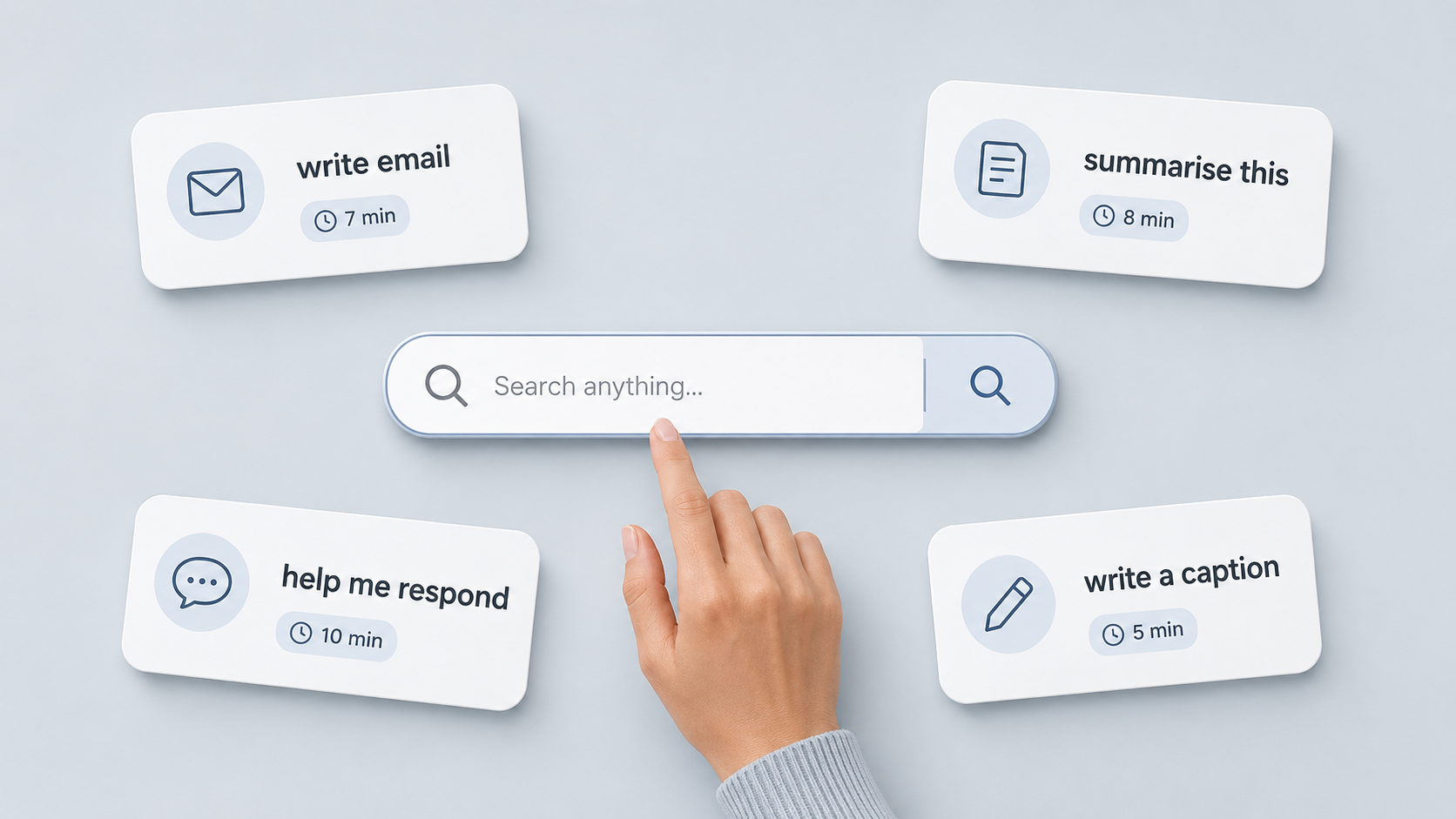
When most people think about using AI for business, they think about asking questions.
“How do I write a follow-up email?”
“What’s a good subject line for this?”
“Summarise this document for me.”
This is the search engine approach to using AI for business. You have a task. You ask AI for help with it. AI gives you something. You take it, modify it, and do the rest yourself.
It feels productive. It is faster than Googling. But it is still fundamentally you doing the work, with AI as a slightly smarter assistant.
The problem: you are still the bottleneck.
Every task that requires your input, your review, your manual step, is a task that can only move as fast as you can. Scale that across a 50-hour week and you have a business that is structurally dependent on your time.
This is not an AI problem. It is a mindset problem. And it’s the most common trap businesses fall into when using AI for business for the first time.
The Operator Mindset (The Shift That Changes Everything)
The operator mindset treats using AI for business differently. Instead of asking AI to help you do a task, you hand the task to AI entirely.
Not “help me write a follow-up email.”
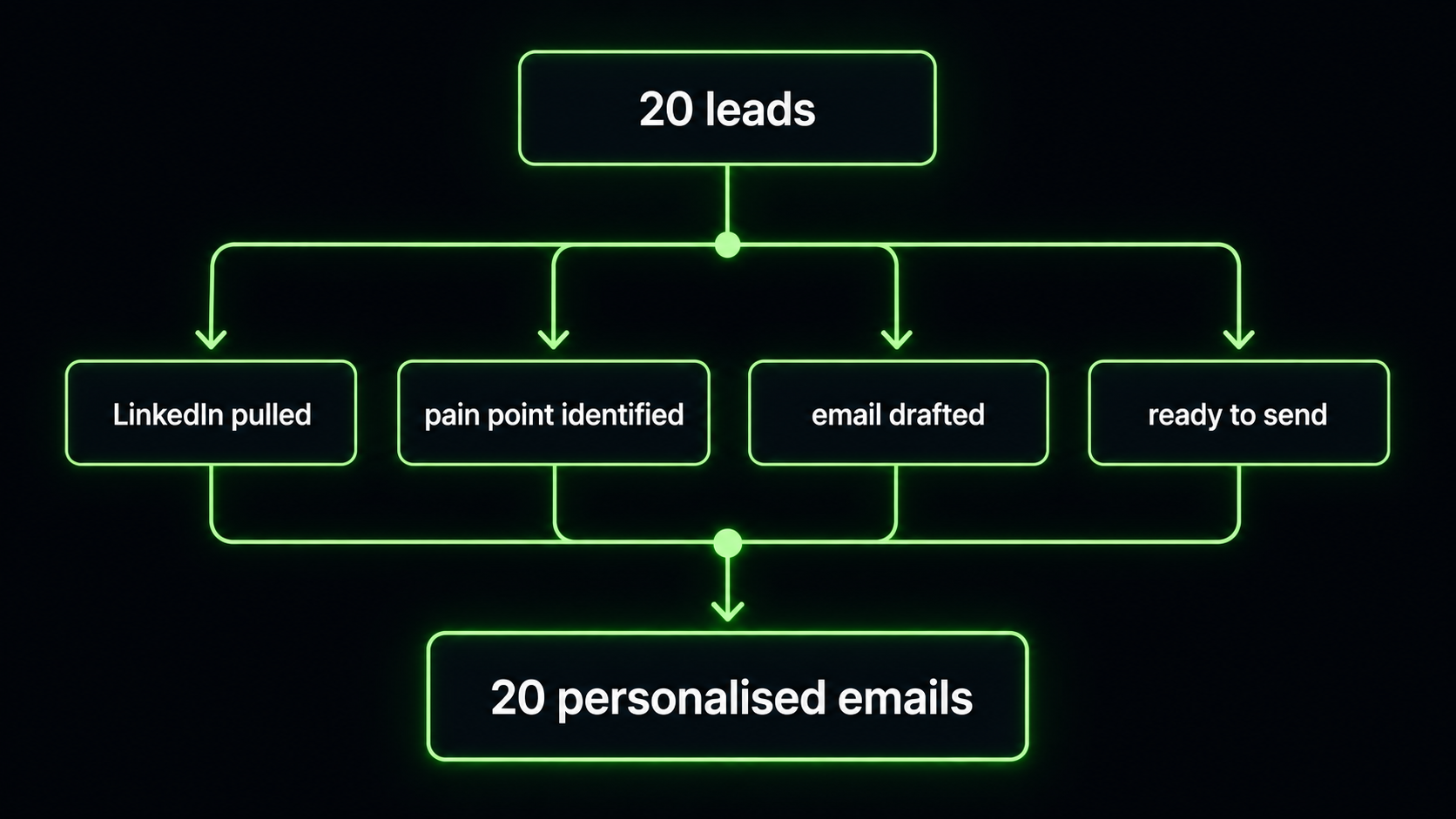
“Here are 20 leads from this week. For each one, pull their LinkedIn, identify the most relevant pain point for their industry, and draft a personalised first-touch email. Output them in a Google Doc, ready to send.”
That is not a query. That is a delegation.
The difference sounds small. The output is an order of magnitude different.
In search engine mode, you save 5 minutes per email. In operator mode, you remove yourself from the email writing process entirely. 20 emails in the time it took you to write one.
This is what using AI for business actually means. Not faster. Removed.
3 Real Examples of Using AI for Business the Right Way
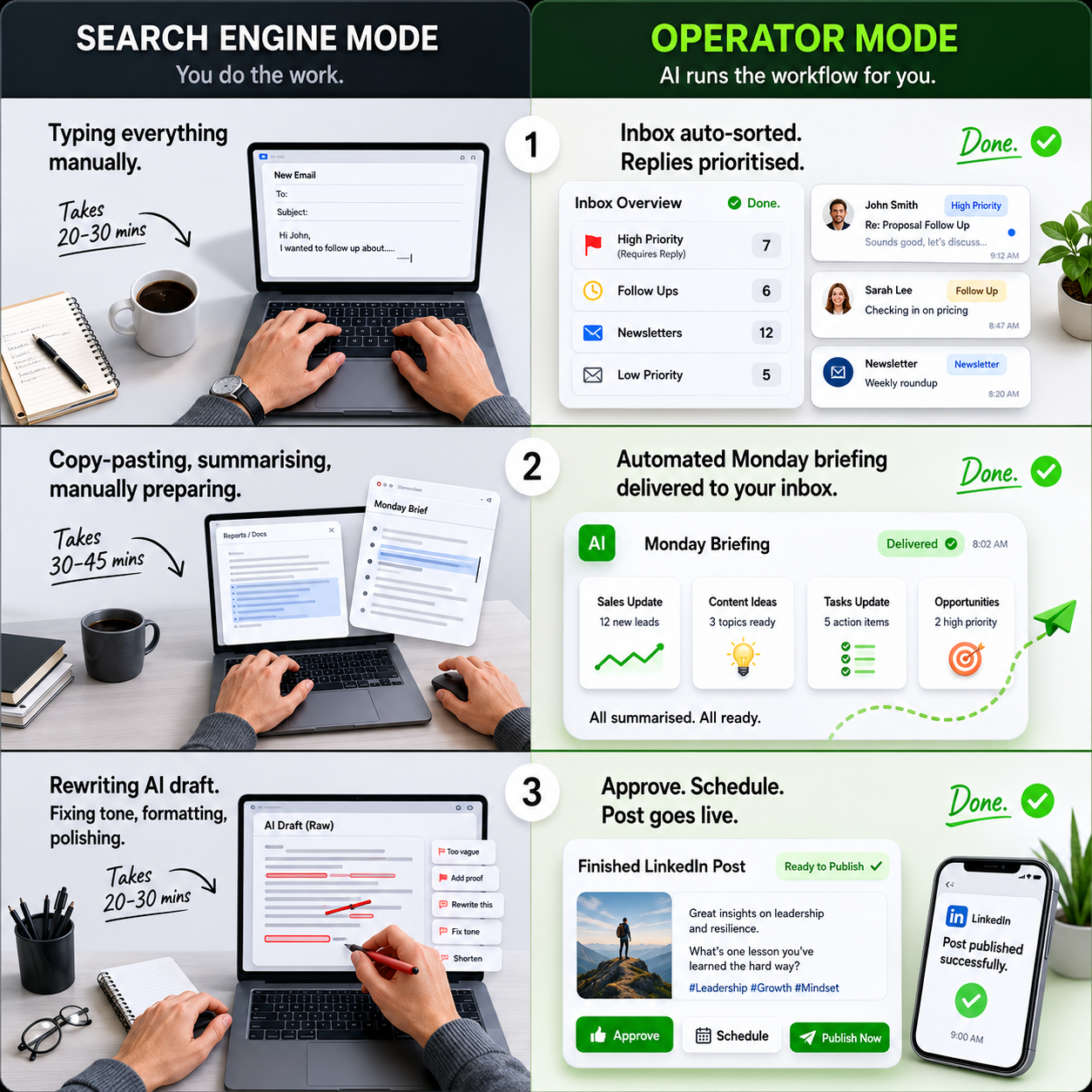
1. From: “Help me respond to this” to “Handle all of this”
Search engine mode: You paste a client email into ChatGPT. Ask for a reply. Edit it. Copy it. Send it.
Time saved: 3 minutes per email.
Operator mode: You set up a system that monitors your inbox, categorises incoming messages by type, drafts responses for routine requests, flags anything that needs your judgment, and surfaces those for a 10-minute daily review.
Time saved: 8 to 12 hours a week. Permanently.
The goal is not a better draft. The goal is to not write drafts at all.
2. From: “Summarise this for me” to “Prepare my week”
Search engine mode: You paste a document into AI and ask for a summary. Read it. Move on.
Time saved: 10 minutes.
Operator mode: Every Monday morning, an automated system pulls last week’s numbers from your CRM, your project tracker, and your inbox. It identifies what moved, what stalled, and what needs a decision from you. It delivers a one-page briefing before you start work.
You never had to ask. It just happened.
3. From: “Write this post” to “Publish this content”
Search engine mode: You describe a post idea to AI. It drafts something. You rewrite 60% of it. You format it. You add images. You publish it.
Time saved: maybe 20 minutes.
Operator mode: You record a 5-minute voice note describing your idea and perspective. A system transcribes it, structures it into a post, matches your voice, formats it for the platform, and queues it for your approval. You read it, approve it, done.
One voice note becomes a published post. Your job is the thinking. Everything else is handled.
Why Most Businesses Using AI for Business Never Make This Shift
Two reasons.
First: the switch feels harder than it is.
Setting up an operator-mode system takes longer than typing a question into ChatGPT. The first time. But a system you build once runs forever. A query you type runs once.
Every hour you spend on setup returns 10, 50, or 100 hours over time. The ROI on using AI for business at the operator level is not incremental. It is compounding. McKinsey’s State of AI research consistently shows that businesses deploying AI at the workflow level, not just the task level, see the biggest gains.
Second: most people do not know what is automatable.
They have been doing their workflow the same way for years. They cannot see where the manual steps are because the manual steps feel normal.
The rule I use: if you do a task more than 3 times a week and it follows a consistent pattern, it can be automated. If it involves moving data from one place to another, it can be automated. If it involves writing something that follows a predictable structure, it can be automated.
Most businesses have 10 to 15 of these tasks hiding in plain sight.
How to Start Using AI for Business Like an Operator
You do not need to automate everything at once. You need to find one task, automate it completely, and watch what changes.
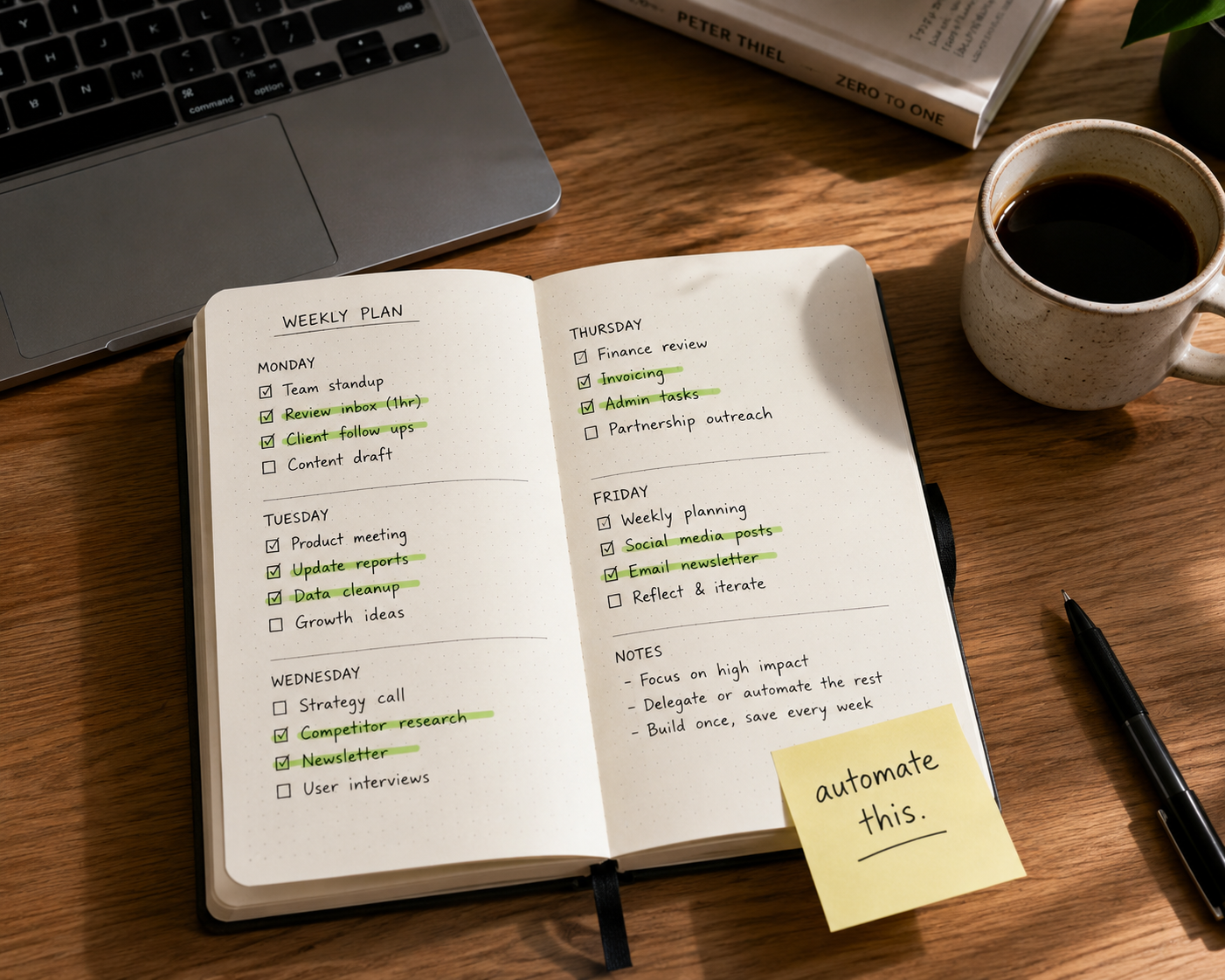
Step 1: List everything you do in a week.
Not a job description. An actual list of every task you did in the past five working days. Be specific. “Responded to client emails” is not specific. “Wrote a status update to Client A, wrote a proposal follow-up to Lead B” is specific.
Step 2: Mark everything that is repetitive and pattern-based.
Highlight anything that happens more than once a week. Anything that follows a structure. Anything where you are moving information from one place to another.
Step 3: Pick the one that costs you the most time.
Not the most interesting. The most time. That is your first automation target.
Step 4: Define the output, not the process.
Do not think about how to automate it yet. Think about what the perfect output looks like. If this task were handled without you, what would land in your hands at the end? Define that clearly. The output definition is what makes a good automation.
Step 5: Build the simplest version first.
The simplest version that works is better than the perfect version that does not exist yet. Get something running. Refine it. Most people spend weeks designing the perfect system and end up with nothing. A working rough version beats a perfect plan every time.
What Changes When You Stop Being the Bottleneck
The most common thing business owners say after their first real automation goes live is: “I wish I’d done this two years ago.”
Not because the automation is impressive. Because of what it reveals.
When you remove yourself from a repeatable task, you see how much of your week was consumed by things that did not require you at all. You see the hours that were occupied but not valuable. You see the space that opens up.
That space is where the real work happens. The thinking, the relationships, the decisions that actually move the business forward.
Using AI for business at this level is not about doing the same things faster. It is about realising which things should not have been on your list in the first place.
Most founders are doing work their business should have outgrown months ago. The shift from search engine to operator is how you stop using AI for business as a crutch and start using it as leverage.
The First Question to Ask Yourself
Not “what AI tools should I use for business?”
Not “how do I learn this?”
The first question is: what did I do this week that I should not have had to do?
Answer that honestly. The automation is usually obvious once you see the question clearly. And that is where using AI for business actually starts.
If you want to see what this looks like in practice, I break down specific automations with real examples in the AI Automation category. Start there.